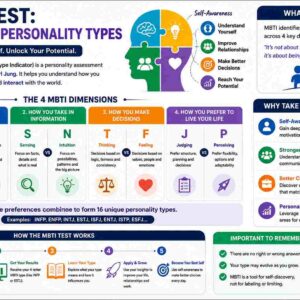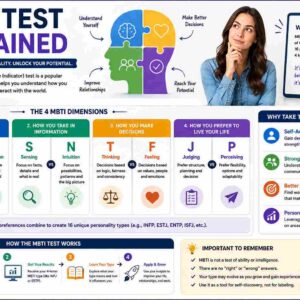




The Myers–Briggs Type Indicator (MBTI) is a popular framework used to understand personality differences and preferences. It groups people into 16 MBTI Personality Types, based on four key pairs of preferences: Extraversion (E) or Introversion (I), Sensing (S) or Intuition (N), Thinking (T) or Feeling (F), and Judging (J) or Perceiving (P). Together, these create a four-letter MBTI personality code such as INFP, ESTJ, or ENTP.
Each MBTI personality reflects how a person tends to gather information, make decisions, and interact with the world. For example, some types are more analytical and structured, while others are more flexible and people-focused. These differences influence many areas of life:
Traits: MBTI personality types highlight natural strengths and blind spots. An INTJ may be strategic and future-oriented, while an ESFP may be spontaneous, energetic, and focused on the present moment. Understanding these patterns can increase self-awareness and help people better manage stress, decision-making, and communication.
Careers: Many people use MBTI to explore career paths that fit their preferences. An ISTJ might thrive in roles that require organization, detail, and reliability, such as accounting or project management. An ENFP, on the other hand, may feel more fulfilled in creative, people-centered fields like marketing, counseling, or entrepreneurship. While MBTI does not dictate career success, it can offer guidance on work environments and tasks that may feel more natural.
Relationships: MBTI personality insights can also be applied to friendships, family dynamics, and romantic relationships. Knowing whether someone prefers Thinking or Feeling, for instance, can explain differences in communication styles or conflict resolution. Partners who understand each other’s MBTI type are often better able to appreciate differences instead of seeing them as flaws, and can adapt their approach to support one another more effectively.
And more: Beyond traits, careers, and relationships, people use MBTI for team-building, leadership development, and personal growth. It can help leaders understand how to motivate diverse team members, assist students in understanding their learning styles, and support individuals in setting goals that align with their natural preferences.
While MBTI should not be seen as a rigid label or a complete description of a person, it offers a useful language for talking about personality. When used thoughtfully, MBTI personality types can provide a structured way to explore who you are, how you relate to others, and how you can create a life and career that fits your natural style.
The term MBTI has become one of the most searched personality-related topics online. From social media discussions to workplace communication and relationship advice, MBTI continues to influence how people understand themselves and others.
MBTI stands for the Myers-Briggs Type Indicator, a personality assessment system designed to identify how people think, make decisions, process information, and interact with the world around them.
Today, millions of people use MBTI to:
- Understand personality traits
- Improve communication
- Explore career strengths
- Build stronger relationships
- Discover personal growth opportunities
The growing popularity of MBTI has made it a major part of modern psychology discussions and internet culture.
Also read:- What Makes Shopify As Your Go-To Ecommerce Website Development Platform?
What Does MBTI Mean?
The Myers-Briggs Type Indicator (MBTI) was developed based on psychological theories created by Carl Jung. The system organizes personalities into 16 unique personality types.
MBTI measures personality using four key categories.
1. Introversion vs Extraversion
This category explains where people gain energy.
- Introverts prefer quiet environments and personal reflection.
- Extraverts enjoy social interaction and active surroundings.
2. Sensing vs Intuition
This dimension explains how people gather information.
- Sensing personalities focus on facts and details.
- Intuitive personalities focus on ideas, patterns, and possibilities.
3. Thinking vs Feeling
This category shows how people make decisions.
- Thinking personalities prioritize logic and objectivity.
- Feeling personalities prioritize emotions and values.
4. Judging vs Perceiving
This dimension describes lifestyle preferences.
- Judging personalities prefer structure and planning.
- Perceiving personalities prefer flexibility and spontaneity.
Combining these categories creates personality types such as:
- INTJ
- INFP
- ENFP
- ESTP
- INFJ
The 16 MBTI Personality Types
The MBTI framework divides personalities into four major groups.
Analysts
- INTJ
- INTP
- ENTJ
- ENTP
These personalities are strategic, logical, and analytical thinkers.
Diplomats
- INFJ
- INFP
- ENFJ
- ENFP
Diplomats are emotionally aware, idealistic, and relationship-focused.
Sentinels
- ISTJ
- ISFJ
- ESTJ
- ESFJ
Sentinels are practical, organized, and dependable.
Explorers
- ISTP
- ISFP
- ESTP
- ESFP
Explorers are adventurous, energetic, and flexible personalities.
Why MBTI Is So Popular
MBTI became popular because people naturally enjoy learning about themselves and understanding human behavior.
The internet helped MBTI grow rapidly through:
- Personality quizzes
- Social media memes
- Character comparisons
- Relationship discussions
- Career advice content
Many users identify strongly with their MBTI personality type and enjoy discussing compatibility, strengths, and weaknesses online.
MBTI and Career Development
One major reason people use MBTI is career guidance.
Different MBTI personalities often prefer different work environments.
For example:
- INTJs may excel in strategy and planning roles.
- ENFPs often thrive in creative or communication-based careers.
- ISTJs usually perform well in structured and organized environments.
Many organizations use MBTI during:
- Team-building exercises
- Leadership training
- Employee development programs
Although MBTI should not be used as the only hiring tool, it can help individuals better understand their workplace strengths.
Also read:- Buy EzoCards Online – Secure, Instant, & Budget-Friendly for Startups
MBTI in Relationships
MBTI is also widely used in relationship discussions.
People often search:
- Which MBTI types are compatible?
- Which personalities communicate best together?
- Which MBTI types are romantic or emotional?
Understanding personality differences can improve:
- Communication
- Emotional awareness
- Conflict resolution
- Relationship compatibility
For example:
- Introverts may need personal space to recharge.
- Extraverts may enjoy constant social interaction.
Learning these differences can help people avoid misunderstandings.
Criticism of MBTI
Despite its popularity, MBTI has received criticism from psychologists and researchers.
Some experts believe:
- Human personalities are too complex for fixed categories.
- Personality test results can change over time.
- Scientific reliability remains debated.
However, millions of people still find MBTI valuable for self-awareness and personal reflection.
Why People Continue Using MBTI
People continue using MBTI because it helps them:
- Understand themselves better
- Learn communication styles
- Explore emotional behavior
- Improve personal growth
MBTI provides a simple and engaging way to explore human personality and behavior patterns.
Final Thoughts
MBTI remains one of the most recognized personality systems in the world. Whether used for self-discovery, career planning, or relationship improvement, the Myers-Briggs Type Indicator continues helping people better understand human behavior.
The growing popularity of MBTI proves that personality psychology continues to fascinate people across all age groups and cultures.
FAQ About MBTI
What does MBTI stand for?
MBTI stands for the Myers-Briggs Type Indicator, a personality assessment system.
How many MBTI personality types are there?
There are 16 MBTI personality types.
Which MBTI type is the rarest?
INFJ is often considered one of the rarest personality types.
Is MBTI scientifically accurate?
MBTI is useful for self-awareness, but some psychologists debate its scientific reliability.
Can MBTI personality types change?
Personality traits may evolve over time due to life experiences and personal growth.
Why is MBTI popular online?
People enjoy personality discussions, compatibility analysis, memes, and self-discovery content.
Author Details:
This is Anil, I am a professional SEO Expert & Write for us technology blog and submit a guest post on different platforms- technootech provides a good opportunity for content writers to submit guest posts on our website. We frequently highlight and tend to showcase guests.