


Introduction
Technology has many informal names, but some are cryptic. An example of this is DH58GOH9.7. Because of these unusual formats, many wonder if it is an application, a version of firmware, a development build, a system component, or just an internal identifier.
This is an even bigger question when one searches any of the following: DH58GOH9.7 software, enhancements for DH58GOH9.7 software, or the future of DH58GOH9.7 software.
Currently, there is no significant public documentation with a decernable author that allows the identification of DH58GOH9.7 as a commercial software product with a stable contractual scope. Public domains describe it in various ways. Some use the terms ‘hypothetical version’, or ‘internal version identifier’, or ‘specialized firmware’ or ‘specialized software’. Do not treat those descriptions as proven technical assessment.
The identifier is important. DH58GOH9.7 may indicate several legitimate applications. Software developers, hardware manufacturers, and testing teams use a large diversity of coding strings as component names, version identifiers, and build identifiers.
Because of this, we have decided to take a conservative position.
We will not assume a specific author of DH58GOH9.7, or that it provides a specific functionality. Instead, we will try to explain what the code may be, the naming conventions of this type, what features to look for to judge the code, how safe it is, and, based on the identifier, what improvements may be made to the software in the future.
What Does the Code DH58GOH9.7 Mean?
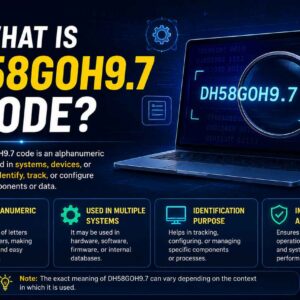
DH58GOH9.7 is a code consisting of letters, numbers, and even a decimal, which seems to classify some sort of build or software version. While many software build versions may be less elegant than consumer software names, they typically follow a similar naming convention.
DH58GOH9.7 may not be the consumer or public name of a piece of software. It could be any number of things, such as:
- a build number,
- a version number,
- an internal label for a piece of software,
- a firmware build,
- a development build,
- a piece of software used for testing,
- a package build,
- a component of a system,
- a piece of software used to configure a system, or
- a piece of software used to build a system,
among other things.
The location of the code would provide additional context to help identify its meaning.
Is DH58GOH9.7 the Name of a Software Product?
Caution is needed at this point. Upon search, information regarding this code is sparse and does not provide a name of an authoring software developer who has described this code. Some sources describe it as a hypothetical versioned identifier, while some sources describe it as a software platform with a name.
Due to the sparse information available, it is best to describe the code as a technical identifier or version identifier, the exact purpose of which is not documented.
A result may show that people are publishing about a term, but it does not confirm that the articles contain claims from the original developer.
Why Does Its Name Resemble a Software Version?
DH58GOH9.7 has a name format that is similar to naming systems for software.
Software systems require names that provide a means for differentiating one build from other builds.
A team could have:
- Development build
- Alpha build
- Beta build
- Test build
- Production build
- Maintenance build
Each of these would be named so that a team could know which build would contain a particular feature or a bug.
9.7 also resembles a build number or a naming version, but as of now, there is no evidence publicly that it refers to build or version “9.7.”
Breaking Down the DH58GOH9.7 Code
It is common to try to assign a meaning to the various parts of a name.
For example, someone could reasonably write that:
- DH is a product family
- 58 is the model of the hardware
- GOH is the software of the hardware
- 9.7 would be the version
That hobby would be naming the code as the author intended, however, no supported evidence exists of such a naming structure.
Each character should not be reinterpreted as a fact if no documentation exists.
It is appropriate to view the entire string as a name, and only in the case that there is technical information to support it, would it be appropriate to interpret the various parts of the string.
Why Do Programmers Use a Code Like DH58GOH9.7?
Technical names or identifiers have utility.
Version Control
It’s important for a development team to know which version of the program is under testing.
Bug Tracking
After a problem report, developers can find the build in question.
Deployment Management
It’s possible to know which version is installed on various systems.
Compatibility
A certain build is expected to work with certain hardware, operating systems, and other software dependencies.
Testing
Builds intended for internal use only may not be made available to the public.
Documentation
Technical teams are able to refer to a certain build without having to rely on a marketing name.
There are many reasons why there are software identifiers that are not common.
Also read:- MailerLite Login
Where Could You Find DH58GOH9.7?
The location of the code can give you very useful information.
Software Settings
You may find it in an application’s:
- About section
- Version information
- System information
- Developer settings
- Diagnostic screen
It may indicate a software build.
Device Settings
If the identifier is in a device’s software settings, it may relate to a firmware build or system build.
Downloaded File
If it is in a filename, it may be a package or release identifier.
System Logs
If it is in logs, it may be a module, service, or build name.
Developer Tools
Developers may see identifiers like this during testing or when debugging.
Enterprise Systems
Privately used business software may take on technical nomenclature that will not be marketed to the public.
DH58GOH9.7 Code in Software Development
Software development typically refers to a number of versions of a single program.
Consider if a development team is working on a program.
They may create different builds for different purposes.
- Build A: Initial Development
- Build B: Bug Fixes
- Build C: Feature Testing
- Build D: Security Testing
- Build E: Production Release
Builds would need unique identifiers.
Something like DH58GOH9.7 could fulfill this need.
As before, this is an example of a possible format, not a known use of such an identifier.
Possible Uses of DH58GOH9.7
Since the exact software is not known, we can not speculate the possible uses with much confidence.
Internal Business Software
A company may have an internal application.
Testing Software
This may be a development or testing build.
Firmware
Some systems have a technical strings of identifiers for their systems firmware.
Backend Software
This may be an identifier for software that is server-side and not directly accessed by users.
Specialized Applications
Some industrial, scientific, or research software may use a technical name as opposed to consumer friendly naming.
Compatibility Builds
This may be a compatibility build for a specific environment.
Possible Features to Look For
Some searches for DH58GOH9.7 locate it in the areas of automation, data, and business software. Most of these descriptions lack supporting evidence and origin from the fields of performance and workflow optimization. Because of this, they are more likely to be features than anything confirmed.
If you have a working installation of the software, features that may be of interest include:
- Business/Process Software
- Version Info
- Settings
- Logs
- Data
- Automate
- Integrate
- Users
- Safety/Control
- Updates
- Reports
- Monitoring
- Performance
The actual features would need to be taken from the software or the developer documentation.
Performance as a Software Characteristic
Performance is a software system characteristic that is important in almost all situations.
If DH58GOH9.7 is a ‘real’ application or internal tool, performance can be assessed using the metrics below.
- Start Up Time
- CPU/Processor
- RAM
- Disk Space/Usage
- Network
- Response Time
- Throughput
- Rate of Errors
Instead of the subjective statement of a certain version being ‘fast,’ these metrics need to be taken in the users’ own environment.
Usability and DH58GOH9.7
The other area of concern is usability.
Technical software can be very powerful and still be very hard to use.
An interface should show:
- What features are
- Where settings are
- How to do common tasks
- What the system did if an error occurred
- What an action was if an error occurred
- Where to get support
If DH58GOH9.7 is used by the general employee or customer, usability should be assessed along with the other aspects of technical performance.
Also read: LASRS Login Guide
Safety and DH58GOH9.7
Safety has to be looked at especially with software that is not known,
Just from the name, you will not be able to tell if DH58GOH9.7 is a safe program or not.
Just because there is an unknown identifier does not mean that it is malware.
However, users should not install software that is not known without checking the source.
Examples of evidence essential for the assessment of software safety include:
- identity of the developer
- source of the downloads
- digital signature
- file integrity
- requested permissions
- network activity
- results of security scans
- documentation
- update history
Assessing the Safety of DH58GOH9.7
If you come across a file named DH58GOH9.7, be cautious.
Where Did You Get That File?
You need to know where the file originated.
The developer’s website or a trusted distribution channel are good, but unknown download sites are bad.
Who Published This File?
You should be able to find the publisher of the file in the properties or installation info.
If a publisher cannot be found, the software is most likely in the beta stage.
Have the File Scanned
Don’t open an unknown executable, or unknown package, without first having it scanned by a reputable security service.
Consider the Requested Permissions
It is a good idea to investigate if an unrelated permission is being requested.
Look for a Manual or Other Official Documentation
Look for a developer’s website or a manual or the release notes or support documentation.
Can a Virus be Named DH58GOH9.7 Code?
Nothing can support that conclusion just based on the name.
It’s completely normal for software identifiers to appear random and meaningless.
Development teams can create technical identifiers that seem irrelevant to the average user.
Also, malware can use technical or random filenames.
Thus, identifiers should not be regarded as proof of danger or safety.
The name does not matter as much as the origin and the behavior.
Why Context Matters more than the Code
Think about two scenarios.
Scenario A
You discover DH58GOH9.7 on the system information screen of a device that you purchased from a reputable vendor.
That context probably means it relates to the device’s software or firmware.
Scenario B
You receive an unexpected email with an attachment named DH58GOH9.7.exe.
That context requires much more caution.
The same appearing string can have very different meanings based on where it is seen. That is why the first step to take is to find the origin.
What to Do if You Want to Find DH58GOH9.7 Software Name
If you want to ascertain that DH58GOH9.7 is a software name and find out if it points to a legitimate application, follow these steps.
Find the Original Location
Note where this name was found.
Find the Related File
If you can, find out which file or process is related to this name.
Evaluate the Publisher
Look for a company or developer name.
Assess the Version Info
Open the software and look at the About page or file properties.
Evaluate Digital Signatures
A valid digital signature may be proof of the publisher and can provide additional support.
Gather Official Sources
Look for manuals, release notes, or support page documentation.
Diversify Your Sources
Don’t depend on just one article. This is especially true in cases where software documentation is sparse.
What is a Digital Signature?
Digital signatures provide confirmation that a signed software file is from a specific publisher and that the file is intact and has not been altered or edited after it was signed.
This can be considered a security measure when it comes to downloadable applications.
That said, digital signatures cannot be considered an all-encompassing assumption of safety of the signed software.
Rather, it is one of many factors that ultimately decides whether the software can be trusted.
Consider the following:
- Who the signer of the software is
- If the signer of the software is the expected publisher
- The source of the file
- What the software is designed to do
Why Does Official Documentation Matter?
Official documentation can provide answers that are not present in search query results.
For example, official documentation may provide answers to the following:
- What DH58GOH9.7 is
- The supported devices
- The supported operating systems
- How it is installed
- What is provided
- What the current version is
- How it is updated
- What common issues may occur and how to resolve them
In the absence of official documentation, third-party documentation must be treated with a high level of skepticism.
What are the Most Common Claims Related to DH58GOH9.7?
There are many different types of claims that can be found in online articles that reference this identifier.
Some of them claim that it is the following:
- An internal software version
- A conceptual software identifier
- An enterprise software platform
- Firmware
- A build of a specialized software
- A modular application
The major issue with all of the aforementioned claims is that they are inconsistent and contradictory.
For example, in the recent past, one article claimed that DH58GOH9.7 is a conceptual or internal identifier, and another reported that it is software designed to assist with automation, data, and workflows.
This inconsistency shows the problem with establishing one description as fact.
Also read:- Likeable Person Test Explained
Evaluating Online Claims Regarding DH58GOH9.7
In a code-related article, ask the following:
Does It Name the Developer?
If not, be careful.
Does It Link to Official Documentation?
If not, claims may be conjectural.
Does It Provide Technical Evidence?
Look for evidence like a screenshot or documentation or release notes.
Do Other Sources Agree?
If completely contradicting claims are present, dig more.
Is the Article a Copy of Another Article?
Repetition of information can lead to false statements.
What Does “Improve DH58GOH9.7 Software” Mean?
The phrase improve DH58GOH9.7 software leads us to believe that users may want to enhance the functionality of a proprietary software system.
It can mean different things to different people.
It could mean:
- Speeding the software up
- Stabilizing the software
- Consuming less memory
- Bug Fixing
- Enhancing security
- Updating libraries
- Modernizing software
- Adding new integrations
- Improving user guides
- Making the infrastructure more modular
- Improving software development practices
These are all software improvement practices, and none are specific to DH58GOH9.7.
Step 1: Understand the Current System
Gather information about:
- What the software does
- Who the users are
- What the user hardware is
- What the software runs on
- What the software is concerned with
- What issues the users have
This information is needed for improvement to know where to start the effort.
Step 2: Measure Performance
Document how the system is currently functioning.
Document how the system is currently functioning. Consider the following:
- CPU usage
- Average latency and throughput
- The crash rate
- Networking activity
These metrics can be referred to later.
Improvements can be evaluated against results held as a baseline.
Step 3: Identify the Biggest Problems
Avoid making undue attempts at progress in multiple areas simultaneously.
Focus on issues that matter most.
As an example:
- High priority: Security issues
- High priority: Software crash
- Medium priority: Slow to generate reports
- Medium priority: Confusing software
- Low priority: Minor appearance issues
Prioritization makes for a more focused development effort.
Step 4: Code Quality
When software is in an active development cycle, the quality of the code should be assessed on a regular basis.
Development teams should look for the presence of any of the following items:
- Duplicate code
- Functions/Methods performing unnecessary calculations
- Poorly constructed and highly complex code
- Poor/Insufficient error handling
- Unnecessary Dependencies
- Memory Leaks
- Lagging Library Dependencies
Clean code is easier to read and maintain.
Step 5: Handling Errors
Good error handling helps both users and developers.
Instead of failing silently, software should be designed to provide useful diagnostic information.
An error message can be designed to communicate to users the following:
- What operation failed
- What component failed
- Whether the failed operation can be safely retried
- What the next step for the user should be
- Where developers can find further information
Step 6: Handling Security
Security can include the following:
- Strong authentication
- Secure storage
- Dependency Updates
- Validating user input
- Vulnerability scans
- Audit logging
Security should be a primary focus for every stage of development.
Step 7: Interface Improvements
For software with a graphical interface, simplification of commonly performed tasks should be a focus.
Good improvements focus on:
- Simpler Menus
- Navigation/Clearer Paths
- Search
- Tooltips
- Status Indicators
- Good error messages
- Support of Accessibility
- Responsive Layouts
An aim of the focus on these priorities should be an interface that helps accomplish goals of the software faster and easier, rather than an interface that focuses solely on looking modern.
Also read:- How Online Slot Games Work
Step 8: Improve Integration
Modern software needs to communicate with different systems.
Depending on the actual use case, integrations could be:
- APIs
- Databases
- Cloud services
- Storage
- Authentication
- Reporting
- Business Systems
APIs have to be documented and secured.
Step 9: Improve Compatibility
Software needs to define its environment when it is executed.
Documentation needs to cover:
- Operating Systems
- Hardware
- Run time
- Browsers
- Databases
- Dependencies
This documentation helps reduce installation and support issues.
Step 10: Improve the Update Process
Software changes are not valuable if users cannot safely apply them.
An effective update system provides:
- Release notes
- Version updates
- Safe downloads
- Verified updates
- Backups
- Rollback
Users need to know what changes are before applying major updates.
How to Improve DH58GOH9.7 Software in the Future
Future development needs to be prioritized for long term sustainability vs. short term fixes.
A valuable roadmap needs several steps aligned with future goals.
Future Stage 1: Better Documentation
Document identifier, architecture, dependencies and supported environments.
Future Stage 2: Performance Monitoring
Integrate reliable metrics and diagnostics.
Future Stage 3: Security Hardening
Review dependencies and vulnerabilities.
Future Stage 4: User Experience
Streamlined design for frequent tasks.
Future Stage 5: Integrations
Documented interfaces.
Future Stage 6: Automated Testing
Development pipeline includes testing.
Future Stage 7: Reliable Releases
Consistent versioning and release notes.
These structured steps can improve the maintenance and reliability of software tools.
Can AI Be Implemented in DH58GOH9.7?
If the processing and automation tasks in the software are actually viable, AI may be incorporated in later versions. Potential uses could be the following:
- Automated anomaly detection
- Intelligent search
- Predictive maintenance
- AI based natural language
- Automated reporting
- Log analysis
- Workflow suggestions
Incorporating AI just because it’s trendy is not a valid reason. A legitimate user problem needs to be identified that AI can address. If the software uses sensitive data, privacy and security will also be factors to consider.
Can Automation Be Implemented on DH58GOH9.7?
Automation is great for removing redundant tasks. An example would be if the software performs the same tasks over and over, the developers could automate the following tasks:
- Data processing
- Report generation
- Backups
- Tests
- Deployment
- Monitoring
- Errors Alerts
Automation should implement safeguards so that if an automated task fails, it does not create a major problem in the system.
How to Enhance the Security of DH58GOH9.7 Software in the Future
Security needs to progress with changing threats. Enhancements for security in the future could be:
- Better Authentication: Use secure methods of authentication.
- Improved Access Controls: Limit users to the permissions necessary.
- Secure Updates: Validate the update packages prior to implementing.
- Better Dependency Monitoring: Track dependency libraries for security issues.
- Improved logging: Only log security events that are necessary to record, informative, and do not log personally sensitive information.
- Regular security reviews: Periodically review security controls.
The Importance of Testing Before Enhancements to Production Software
One of the major failures of software developers is to modify a live production system with no testing. A better practice would be to do the following:
- Make the change.
- Test in development.
- Test in staging.
- Review the results.
- Create a backup.
- Deploy the change in increments.
- Monitor the system.
This practice results in lower the risk of introducing a new problem while addressing a different problem.
Also read:- AaryaEditz org Overview
Can DH58GOH9.7 be Self-Modified by Users?
This is contingent on what the identifier means.
If it’s an application, users might be able to:
- Replace it
- Change application settings
- Delete data caches
- Uninstall plugins
- Optimize the application based on the given guidelines
If it’s firmware or a component, then users should be more careful.
Never modify system software unless you know what it controls.
What Should You Not Do?
If you are not familiar with the software identifier, do not:
- Install a variety of versions
- Install pirated versions
- Edit system files without creating a backup
- Install firmware updates from untrusted sources
- Disable your antivirus
- Run an untrusted file as an admin
- Follow unverified instructions from discussion boards
- Delete files because their names look suspicious
Technical “hacks” should only be conducted if you have verified information.
DH58GOH9.7 and Software Maintenance
Once software is released, the maintenance should not be considered complete.
Further maintenance may include:
- Patching bugs
- Updating security
- Improving compatibility (with other software)
- Optimizing performance
- Updating documentation
- Improving support for users
- Updating and managing dependencies
If DH58GOH9.7 is a software project, then lack of maintenance would significantly reduce reliability.
Version Control and Why It’s Important
If a company has multiple installations of a program with many versions and little version control, then it would be difficult to figure out any of the following:
- Which installation is the most up to date?
- Which installation contains the version with all the security updates?
- Which version is the cause of a given bug?
- Which version contains the update related to a given bug?
- Which version should be supported?
- Which version other installations should be updated to?
A good version control system answers all of these questions.
If DH58GOH9.7 is a version control identifier, then creating documentation on what the version control numbers mean would be very helpful.
What Users Should Do If They Find DH58GOH9.7 Unexpectedly
Do not delete it right away.
First:
- Identify where it is located.
- Locate the software or file it belongs to.
- Evaluate the publisher.
- Evaluate the time it showed up.
- Analyze your recent installations or updates.
- Scan any files you consider suspicious.
- Research the origin.
- Notify the publisher of the software or the manufacturer of the device if needed.
Deleting components of the system you do not recognize can be more harmful than leaving them there to continue your assessment.
When Should You Be Concerned?
If the only thing you notice that is unfamiliar is a code, you do not have to be worried.
If something:
- Shows up unexpectedly,
- Has shown up after an unknown download,
- Requests permissions that you deem to be unnecessary,
- Starts executing on its own,
- Shows up in the task manager as a process that takes up a disproportionate amount of resources,
- Connects to a remote network that you are not familiar with
- Is flagged by your security software,
- Causes your system to crash or otherwise behave erratically,
then you should begin your assessment of the situation.
A Practical Safety Checklist
Before trusting software associated with DH58GOH9.7, consider:
- The creator
- The origin
- The existence of official documentation
- The digital signature of the file
- The publisher’s legitimacy
- Requested permissions
- Security software flags
- Existence of an official update mechanism
- Normal removal capability
- Existence of a backup or recovery process.
If you are unable to answer positively these concerns, investigate the software.
Frequently Asked Questions
What is the DH58GOH9.7 code?
The nature of the code DH58GOH9.7 is an unusual technical or version-style identifier and is not clearly established by authoritative developer documentation.
Is DH58GOH9.7 a name of a software?
While there is inadequate reliable public documentation to substantiate that DH58GOH9.7 is a name of a mainstream software product, it could be a software/build identifier.
What does DH58GOH9.7 signify?
Without documentation, it would be conjectural to provide meaning to the components of DH58GOH9.7 as it has the structure of a version control number or technical identifier. However, similar to many technical identifiers that follow a particular structure, the individual components of this identifier will not have a specific meaning.
Is DH58GOH9.7 safe?
By itself, the name does not indicate that the software is unsafe. You should look at the source, publisher, digital signature, permissions the software is requesting, its behavior, and the results of a security scan.
Is DH58GOH9.7 malware?
There is no reliable way to claim that this identifier is a malware. Just because a build identifier or a file name is unusual, it does not mean that it is malware.
Where could you find DH58GOH9.7?
It could be referenced in software, files that get downloaded, system logs, firmware, and in a variety of other places in a technical context.
How do I locate DH58GOH9.7?
First check where you found the identifier. Then check the file, the publisher, the developer, the version, the digital signature, and the source where you downloaded it from.
What is software named DH58GOH9.7?
This is a name people use to search for an unusual software identifier. There are no consistent public descriptions that cover it. So we will consider it as an unverified technical name or version control name. There are no published records to show otherwise.
Is it possible to make improvements to DH58GOH9.7?
If you own a legitimate software product represented by this identifier, some general enhancements could be software performance, error handling, user experience, security and usability, software and hardware compatibility and extensibility, documentation, testing and updating the software.
What would be the best approach for enhancing DH58GOH9.7 software in the future?
Start improving software by measuring and assessing the present state of the software and the priority of the weak areas. First, validate improvements at an appropriate scope by conducting necessary changes in a testing or staging environment, and ensure to assess and monitor the change impacts after the software has been deployed.
Is it possible for DH58GOH9.7 to be firmware?
It may be possible for a coding format such as this to represent firmware or a system build, however, there is not enough evidence to validate or support that this coding format is firmware.
Is it safe to install DH58GOH9.7 software?
You should not install any unknown software simply based on the name. Always check the developer, source, signature, documentation, and security status before installation.
Is it possible to uninstall DH58GOH9.7?
This is entirely dependent on the system. If this identifier represents a regular external application, it is probable that you can uninstall it. However, if it represents system firmware or a system application, then it is likely that the functionality and security of the system can be impacted.
What is the reason for the difference between the various descriptions of DH58GOH9.7?
This identifier has very scant documentation, most of which is unofficial. The scarcity often leads pages and sites to post their own interpretations. Some pages even refer to this identifier as a hypothetical or an internal identifier, while some others make claims that are more elaborate, however, these claims often lack sourcing.
Can all articles regarding DH58GOH9.7 be considered true?
No. As with any other software or system product, you must verify with the original or most recent authoritative documentation or cite reliable technical evidence. Just because a number of sites or pages make the same statement regarding a product does not mean those claims are valid.
Conclusion
There is no known public or official definition for the DH58GOH9.7 code and we only have limited information available. The code appears to be some form of a technical identifier. In many cases, similar identifiers represent the name, number, or version of a particular module, or software or firmware build. In this case, the name is of a proprietary or internal system or testing environment.
Without context, the actual value of these codes is negligible.
While investigating codes and identifiers, context is extremely important. If DH58GOH9.7 is found in a software configuration, it is likely to be some version or build number of that software. If it is seen in system settings, it is likely a firmware version or some component of the system. It is important to understand the publisher and the source of any file before it is downloaded and installed to a system.
The name or code alone cannot be the basis to establish the safety of a file. It is unwise to install software with unknown codes or names based on the assumption that it is not harmful. There are a number of ways to evaluate and establish the safety and trustworthiness of a file or a system. It is important to implement a defense in depth approach to the safety of DH58GOH9.7 software. Safety, performance and the user experience are among the many important and measurable areas where software can be improved.
For the purpose of safety and security of the DH58GOH9.7, it is recommended to implement the measurable improvements outlined in this document.
The best method for decoding DH58GOH9.7. is not to logically assume what each letter or digit may signify. Instead, trace the origin of the code, recognize the software or device it is associated with, confirm the publisher of the code, and search for legitimate technical documentation.
Deconstructing the code using the step-by-step method described above yields a much better result than attempting to derive meaning based on a name that is cryptic or foreign.
Author Details:
This is Anil, I am a professional SEO Expert &Write for us technologyblog and submit a guest post on different platforms- technootech provides a good opportunity for content writers to submit guest posts on our website. We frequently highlight and tend to showcase guests.