



Have you wondered why differences in people’s personalities lead to them enjoying or being uncomfortable in large gatherings? Why do some members of society prefer to make logical decisions while others make emotional decisions? Why do some members of society prefer to create plans while others prefer to be spontaneous?
The Myers-Briggs test is one of the most popular personality tests in the world. Every year, millions of people use the test to gain a better understanding of themselves, describe their relationships with others, and choose careers to improve their collaborations with others.
Are you interested in looking for the meaning of an MBTI, explanations of an MBTI, understanding the MBTI personalities, and the various MBTI types? This guide should provide you with the answers to all of your questions.
In the guide, you should be able to find an explanation of the test and the significance of each of the personality preferences. You will find an exploration of the 16 personality types, and a discussion of personality traits. You will find explanations of the terms that you have been searching for (XNXP personality type), and an example of how to interpret your results to find the areas you are able to grow the most, and your strengths.
What is the MBTI Test?
The MBTI Test is a type of personality assessment that allows you to classify how individuals decide to perceive the world, the way they choose to conduct themselves, and the way that they choose to interact with others.
Unlike other personality assessments that focus on measuring the intelligence of an individual, this personality test is focused on the preferences of individuals’ personalities.
The MBTI was created to type individuals into one of the 16 personality types that are derived from 4 letters.
Some of the types are:
- INTJ
- INFP
- ENFP
- ESTJ
- ISFJ
- ENTP
- INFJ
- ESFP
Each of the personality types created by this method represents an exclusive pattern of preference for communication, motivation, and actions.
Unlike assessments that measure your IQ, there are no assessments that are considered wrong for this type of personality test. Each of the personality types has their own advantages, disadvantages, and areas in which they can improve.
What are the MBTI Categories?
Many individuals want to know about the MBTI, and more specifically, what the MBTI categories are.
MBTI is an acronym for:
Myers-Briggs Type Indicator
The purpose of the assessment is to identify the differences in personality and assist in the development of interpersonal relationships, education, and careers.
The assessment is not intended to box people into categories, but rather provide clues to their preferences.
Who Invented the Myers-Briggs Personality Assessment?
The Myers-Briggs Type Indicator was invented by Katharine Cook Briggs and her daughter, Isabel Briggs Myers.
The development of the assessment was the first time that the psychological theories of Swiss psychiatrist Carl Jung were applied to a model that could be used by the public.
Currently, there are numerous professional application fields for the MBTI:
- Career planning
- Development of leaders
- Creation of teams
- Training in an organization
- Education
- Improvement of individuals
- Coaching in relationships
There are many critics of the MBTI and its scientific value; however, a large number of individuals use the assessment as a tool for self-exploration.
What is the Process of the MBTI Assessment?
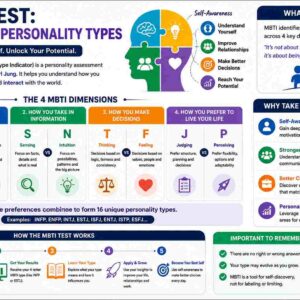
The MBTI assessment is a test of personality that evaluates four pairs of preferences.
For each of the four pairs of preferences, people tend to choose a preference.
From the preferences selected, a personality type is assigned from the 16 MBTI personality types.
In the following sections, we will examine the preferences more closely.
Extraversion (E) vs. Introversion (I)
This preference identifies the source of energy for individuals.
Extraversion
People with Extraversion tend to like social interaction, thinking out loud, and group activities, and tend to feel energized when in the presence of others; favor active environments.
Introversion
People with Introversion tend to like spending time alone, think before they speak, prefer to have conversations that are meaningful, and tend to be energized by quiet time. They are better able to concentrate on activities that are done alone.
Introversion and Extraversion are equally valuable. They show the ways that people prefer to use their time and where people derive their energy from.
Sensing versus Intuition
This distinction refers to the method of perception and how one takes in and interprets information.
Sensing
Individuals with a preference for Sensing are more likely to be detail oriented, focused on the facts, appreciate and trust practical solutions, and are evidence based.
Intuition
Individuals who have a preference for Intuition enjoy abstract thoughts, are more likely to recognize patterns, appreciate and imagine possible scenarios and outcomes, and are willing to explore.
Intuitive personalities like to innovate, whereas Sensing personalities like to implement the ideas and innovations in a practical manner.
Thinking versus Feeling
This distinction refers to the styles of decision making.
Thinking
Individuals who have a preference for Thinking enjoy the use of logical analysis, appreciate the value of fairness in decision making, and enjoy the systematic solving of problems. They appreciate and endorse clarity.
Feeling
Individuals with a preference for Feeling enjoy the use of empathy and appreciate harmony in their decisions. They show a value-based approach to decisions and are focused on people.
Both styles of decision making and perceptions of situations are valuable in both personal and professional contexts.
Judging versus Perceiving
This distinction refers to preference in the organization and structuring of time.
Judging
Individuals with a preference for Judging enjoy and appreciate structures and plans. They prefer to complete tasks in a timely manner and appreciate people and time being organized.
Perceiving
Individuals with a preference for Perceiving enjoy and appreciate structures and plans. They prefer to complete tasks in a timely manner and appreciate people and time being organized.
There is no value placed on preference for Judging or Preference for Perceiving. They show diverse preference and structuring of time and life.
Also read:- What Is Vezgieclaptezims?
Understanding the 16 MBTI Personality Types
The 4 pairs of preferences result in 16 distinct personality types. They can be combined as follows.
Analyst Types
- INTJ
- INTP
- ENTJ
- ENTP
Diplomat Types
- INFJ
- INFP
- ENFJ
- ENFP
Sentinel Types
- ISTJ
- ISFJ
- ESTJ
- ESFJ
Explorer Types
- ISTP
- ISFP
- ESTP
- ESFP
Each of the personality types represents a different mix of potential strengths and preferred methods of communication and decision-making.
MBTI Personality Type Descriptions
INTJ – The Strategist
INTJs prefer to work alone, think, and analyze to solve difficult problems, and enjoy creating plans for the long-term future.
Strengths
- Strategic thinking
- Independence
- Analysis
- Long-term thinking
INTP – The Thinker
INTPs are fascinated by the world and enjoy the exploration of new and old ideas, theories, and concepts, especially those that are able to bring some kind of innovation.
Strengths
- Creativity
- Curiosity
- Problem-solving
- Analysis
ENTJ – The Commander
ENTJs prefer leading the charge and enjoy bringing structure to the means of achieving a goal.
Strengths
- Leadership
- Confidence
- Decisiveness
- Organizational skills
ENTP – The Debater
ENTPs are innovative, communicative, and creative, and prefer to think of and discuss new ideas and solutions to problems.
Strengths
- Innovation
- Adaptability
- Communication
- Creativity
INFJ – The Advocate
Thoughtfulness, driven goal-seeking, and compassion are the main attributes of the personality type of an INFJ.
Strengths
- Empathy
- Insight
- Vision
- Dedication
INFP – The Mediator
The Mediator personality type is compassionate and creative with a strong sense and appreciation of loyalty and authenticity.
Strengths
- Compassion
- Creativity
- Loyalty
- Open-mindedness
ENFJ – The Protagonist
The Protagonist personality type enjoys teamwork and is driven to motivate, communicate, and empathize with all.
Strengths
- Motivation
- Communication
- Emotional intelligence
- Teamwork
ISTJ – The Inspector
If you are in the ISTJ group, you are the most dependable, practical, and organized. Because you value responsibility and consistency, you are known for your strong work ethic.
Common Traits
- Honest
- Reliable
- Detail-oriented
- Organized
- Responsible
Best Career Matches
- Accountant
- Engineer
- Military Officer
- Auditor
- Project Manager
ISFJ – The Defender
If you are in the ISFJ group, you are caring, loyal, and supportive. You are a person who enjoys helping behind the scenes.
Common Traits
- Compassionate
- Patient
- Dependable
- Observant
- Humble
Best Career Matches
- Nurse
- Teacher
- Social Worker
- Healthcare Professional
- Administrative Specialist
ESTJ – The Executive
As an ESTJ, you enjoy creating structure and maintaining order. Because you excel at organizing people and projects, you naturally take leadership roles.
Common Traits
- Efficient
- Practical
- Confident
- Organized
- Decisive
Best Career Matches
- Business Manager
- Police Officer
- Judge
- Operations Manager
- Government Administrator
ESFJ – The Consul
ESFJs are warm, outgoing people who enjoy building relationships and helping communities thrive.
Common Traits
- Friendly
- Caring
- Cooperative
- Loyal
- Organized
Best Career Matches
- Human Resources
- Customer Service
- Event Planner
- Teacher
- Hospitality Manager
ISTP – The Virtuoso
As an ISTP, you enjoy solving practical problems and love working with tools, technology, or machinery.
Common Traits
- Independent
- Logical
- Calm
- Curious
- Hands-on
Best Career Matches
- Mechanic
- Software Developer
- Pilot
- Electrician
- Engineer
ISFP – The Adventurer
As an Adventurer, you are artistic, flexible, and are deeply connected to your personal values.
Common Traits
- Creative
- Gentle
- Adaptable
- Sensitive
- Artistic
Best Career Matches
- Graphic Designer
- Photographer
- Interior Designer
- Musician
- Fashion Designer
ESTP – The Entrepreneur
The Entrepreneur group enjoys excitement, action, and solving challenges that are immediate.
Common Traits
- Energetic
- Bold
- Practical
- Social
- Competitive
Best Career Matches
- Sales Executive
- Entrepreneur
- Marketing Professional
- Emergency Responder
- Sports Coach
ESFP – The Entertainer
ESFPs bring enthusiasm, fun, and energy into every environment.
Common Traits
- Friendly
- Outgoing
- Energetic
- Optimistic
- Spontaneous
Best Career Matches
- Actor
- Public Relations Specialist
- Event Coordinator
- Travel Consultant
- Sales Professional
MBTI Traits Explained
Each MBTI personality type encompasses an array of positive attributes and potential drawbacks.
Common Positive Traits
- Leadership
- Creativity
- Rationality
- Emotional Intelligence
- Adaptability
- Organizational Skills
- Communication
- Problem-solving
- Curiosity
- Empathy
Potential Pitfalls
- Overthinking
- Perfectionism
- Impulsivity
- Difficulty Expressing Emotions
- Resistance to Change
- Avoiding Conflicts
- Gaps in Stress Management
Knowing both your potential and your pitfalls will help advance your own development and further collaboration with others.
MBTI Strategies for Personal Development
Understanding your MBTI personality can aid you in the deliberate improvement of various aspects of your existence.
Enhancing Communication
Understand your personality’s innate communication style and learn to adapt your style to your audience.
Elevate your Emotional Intelligence
Learn to recognize the Emotional aspect of your Rational Decisions.
Stress Management
Understand your personality’s innate Stress Responses, recognize your Healthy vs. Unhealthy coping mechanisms, and adapt accordingly.
Habit Building
Understand your personality’s innate attributes that will help you build your Habits, and learn to adapt your methods accordingly.
Using MBTI in Career Exploration
The MBTI personality inventory is used primarily in career exploration.
Although there isn’t an MBTI personality type that excludes a certain Job or Career, knowing your personality preferences will help you understand which Workspaces and Jobs will help you stay motivated.
| Personality Preference | Often Enjoys |
|---|---|
| Introverts | Independent work, research, writing |
| Extraverts | Sales, leadership, networking |
| Thinkers | Engineering, finance, technology |
| Feelers | Healthcare, education, counseling |
| Judging Types | Structured organizations |
| Perceiving Types | Flexible and creative workplaces |
Career satisfaction comprises many elements. Thus, the MBTI should be one perspective among many others, rather than a rigid career determinant.
MBTI in Relationships
Personality distinctions bring forth unique communication styles, conflict resolutions, and relationship expectations.
Using the MBTI model, partners have the ability to explain the discrepancies present in their differing situational approaches.
Examples:
- Introverts recharge in quiet settings.
- Extraverts recharge by spending time with others.
- Thinking types look at the problem and provide a solution during conflict.
- Feeling types look at the problem and provide emotional support.
Identifying these tendencies fosters understanding and lessens the gap created by misconceptions.
What is an XNXP Personality Type?
XNXP personality type, XNXP personality type traits, and XNXP personality type test are common search items.
In MBTI, “XNXP” is not an official classification. Rather, it denotes an informal classification of people that share a significant number of similarities, with one of the letters being undecided.
To break it down:
- X = Introversion (I) or Extraversion (E)
- N = Intuition
- X = Thinking (T) or Feeling (F)
- P = Perceiving
Someone that identifies as an XNXP usually favors Intuition and Perception, but is not certain of their Introversion/Extraversion or Thinking/Feeling preference.
This classification is used during personality exploration and is a way to denote a broad classification of MBTI before they finalize their typology.
XNXP Personality Traits
Those identifying as XNXP might have the following broad traits in common:
- Curiosity
- Creativity
- Open-mindedness
- Flexibility
- Imagination
- Enjoy the exploration of ideas
- Quick to adapt to change
- Preference for potential over definite routines
These traits are simply general preferences and are not traits of a defined cognitive category within the MBTI.
XNXP Personality Type 1 and Type 2
Out of curiosity, people search for “XNXP personality type 1” and “XNXP personality type 2”. However, these are not formally defined categories of the Myers-Briggs system.
Most of the time, they refer to informal quizzes, blogs, and/or forums, and not the established MBTI system.
If you come across these terms, make sure to check the references and sources as they do not refer to the official Myers-Briggs personality types.
What Is the XNNXJ Personality Type Test?
The term “XNNXJ personality type test” is something else that people tend to search for.
Like searches for XNXP, this is an informal designation of the MBTI system. In most instances, it is a vague, unclear, or incomplete personality code that is used in some online tests during the guesswork phase of users defining their preferences.
Official results of the MBTI do not support this practice and will contain one of the 16 personality types of the formal system.
XNXP Personality Type Test 2024 English
Another search that we notice is for “XNXP personality type test 2024 English”.
In most instances, this search refers to an English online personality test. Although these tests can be fun or interesting, results may vary based on the author’s expertise or the quality of interpreting the test items, and the logic they are grounded on.
Asking what your personality is like takes a look at a handful of factors that most reputable personality tests have in common, and it can encourage informed initial steps into self-awareness.
Common Misunderstandings Regarding the MBTI
As with any trending phenomenon, the Myers-Briggs Type Indicator has a handful of misunderstandings associated with it. The following five misconceptions of the MBTI will clarify the reality of this personality style classification in order to allow effective utility of the structure.
Myth 1: The MBTI Assesses Intelligence
Reality: The MBTI does not have the qualitative nature or structure to assess someone’s IQ, knowledge, or intelligence. The MBTI is a convenience to view how someone has a preference to interact with the world and how the individual has a preference to make decisions and perceive information.
Myth 2: MBTI Type Rankings Exist
No MBTI type has a monopoly to superior strengths or weaknesses.
Some examples of differing strengths include:
- Strategic planning may be the strength of an INTJ.
- Creativity and enthusiasm may be a strength of an ENFP.
- Reliability may be a strength of an ISTJ.
- The ability to foster relationships may be a strength of an ESFJ.
Myth 3: Personality Type is Permanent
Although preferences to various traits may remain constant, and be considered “natural,” personality is flexible and dynamic.
Growth is possible through experiences, education, and employment. New skills can be developed and practiced.
People may begin to embrace traits that are not as preferred.
Myth 4: MBTI Determines Career Success
The MBTI can inform on preferences when it comes to work/personal life, but it does not equate success to any particular career.
Factors that determine success include:
- Education
- Experience
- Personal drive and outlook
- Opportunity
- Skills of the individual
Understanding Your MBTI Type
Learning about personality and the MBTI has the potential of gaining one’s self-awareness, which is why so many people tend to find it advantageous.
Personal Benefits
- Improved Self Awareness
- Increased Confidence
- Better Communication
- Improved Decision Making
- Better Emotional Understanding
Professional Benefits
- Effective Teamwork
- Improved Leadership
- Enhanced Cooperation
- Better Conflict Resolution
- Help in Career Planning
Relationship Benefits
- Better Communication
- Increased Empathy
- Improved Boundaries
- Better Conflict Resolution
- Stronger Friendships and Partnerships
Limitations of the MBTI Personality Test
There are many things you need to be aware of regarding the limitations of the MBTI.
1. Not a Clinical Tool
The MBTI was created to understand personality functions, not to assess mental disorders.
2. Results are Inconsistent
People may receive different results at different times, especially if they are near the middle of the preference scales.
3. Personality is Complicated
It is impossible to reduce a person to a self-contained four letter abbreviation.
Culture, environment, personal experiences, and values shape personality beyond the MBTI framework.
This is why the MBTI is best used as a self-reflection tool instead of placing definitive labels.
MBTI vs. Other Personality Assessments
There are many different personality models and systems and they all serve different functions.
| Assessment | Focus |
|---|---|
| MBTI | Personality preferences |
| Big Five | Personality traits on a continuum |
| DISC | Workplace communication and behavior |
| Enneagram | Deep motivations and fears |
| Strengths Assessments | Talents and strengths |
Different personality assessments serve different functions. There is a reason that many people use different assessments to understand different things about themselves.
Guidelines for Taking an MBTI Personality Test
To get the most meaningful results:
Answer Honestly
Choose responses that you think reflect your real preferences the most, not the people you think you should be.
Don’t dwell
Your gut response is often the most precise answer.
Think about habitual actions
Try to remember your actions over the long term and not just the actions that brought you to the present situation.
Be receptive to self-reflection
Your personality type can provide an indication of your personality, but it is not a permanent classification.
Why the MBTI is still popular
The Myers-Briggs Type Indicator is still one of the most famous personality assessment systems because it is:
- Simple
- Applicable to so many situations
- Useful for team-building activities
- In demand during the career planning cycle
- An interesting system for setting and reviewing personal goals
- Catered to improve interpersonal communication
The four-letter system is a way for so many people to engage with theories of personality.
In Summary
It is not a surprise that the MBTI Test is one of the most popular personality assessment system in the world. MBTI, and its associated concepts, offer users the opportunity to better understand their communication style, their approach to learning, the way they process information, and their relationships.
The MBTI system, and its associated concepts, provides users with the opportunity to better understand their communication style, their approach to learning, the way they process information, and their relationships.
The MBTI system, and its associated concepts, provides users with the opportunity to better understand their communication style, their approach to learning, the way they process information, and their relationships. While personality assessments can provide users with a framework, they should not be considered the sole means of understanding personality. The framework of the MBTI system should be used to understand and appreciate yourself and others.
Frequently Asked Questions (FAQs)
What does MBTI mean?
The Myers Briggs Type Indicator is an assessment of personality based on psychological preference.
What is the MBTI test used for?
The MBTI assesses an individual’s understanding of their preferences, communication styles, decision making, and strengths.
How many types are in the MBTI?
The MBTI consists of 16 personality types.
Are MBTI tests accurate?
The MBTI is indeterminate, as is the case of many personality tests, but it can be useful for the self-reflective process of an individual.
What does XNXP mean?
XNXP is an informal shorthand for an MBTI type of which the individual is unsure of the preference letters aside from N (Intuition) and P (Perceiving).
Is the XNXP type 1 or type 2?
The XNXP type is neither type 1, nor type 2 of the MBTI, as these types derive from informal personality tests and online discussions, rather than the Myers-Briggs system.
Can your type change in MBTI?
Your type cannot change in MBTI, but your preferences may change if, for example, you age, or as a result of your life experiences.
Is MBTI good for assessing career paths?
The MBTI can tell an individual a lot about their preferences for work and even their ideal work environment; however, it doesn’t allow for an individual to assess their interests, skills, values or education.